WIND & ENERGY 25 October 2026
Pakistan’s Gharo–Keti Bandar Wind Corridor Could Power a Third of the Country
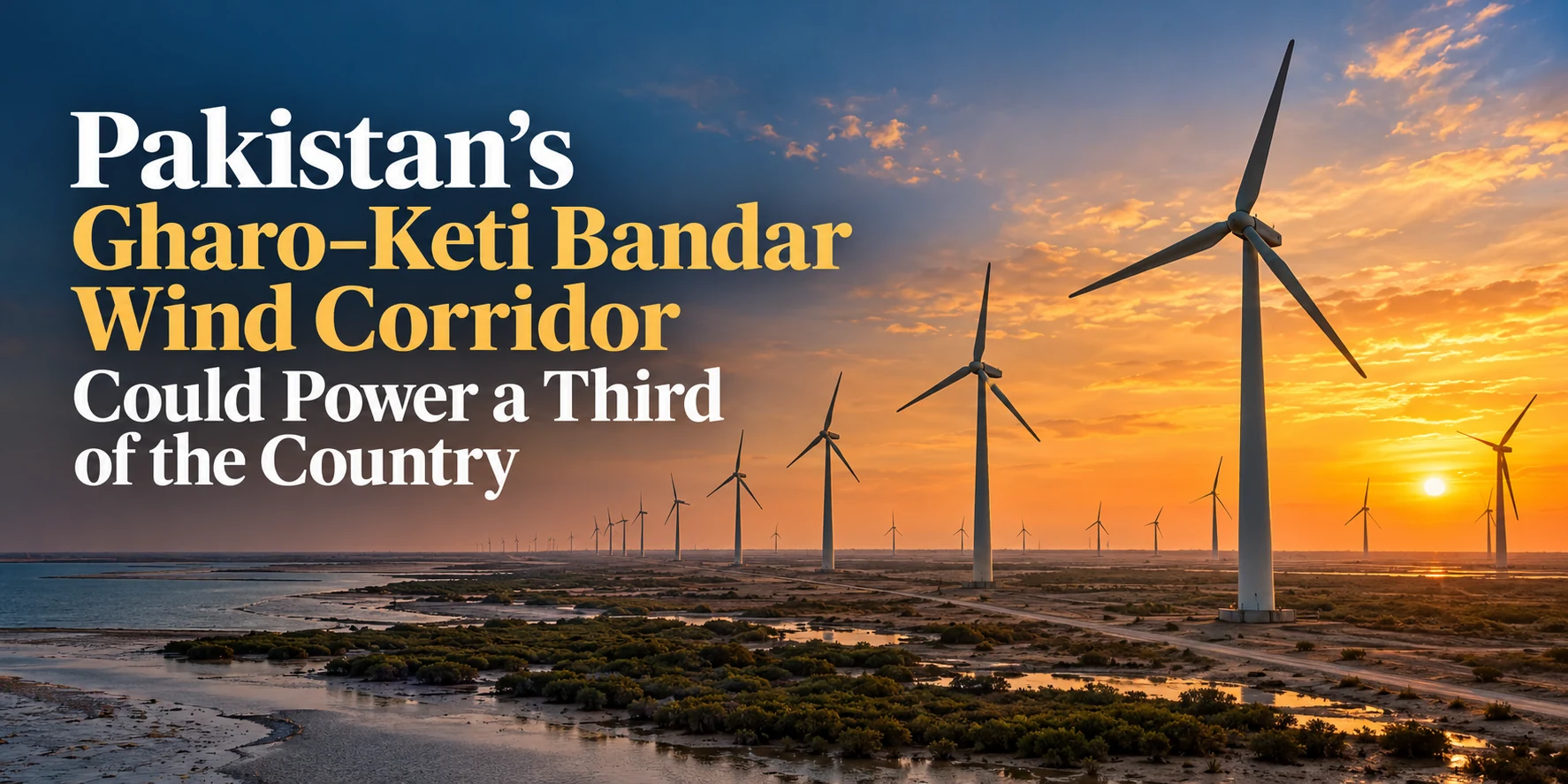
Pakistan’s Gharo–Keti Bandar Wind Corridor Could Power a Third of the Country
Pakistan has one of South Asia’s most promising onshore wind resources along the coast of Sindh. Yet, despite decades of research identifying its potential, much of this resource remains undeveloped.
Pakistan’s energy debate often focuses on expensive electricity, imported fuels, circular debt, and the growing cost of keeping the national grid running. But along the southern coast of Sindh lies a resource that could help address several of these challenges: wind.
The Gharo–Jhimpir–Keti Bandar wind corridor is one of Pakistan’s most promising locations for large-scale wind power. Research has identified a wind resource exceeding 50,000 megawatts (MW), while a substantial share of that potential could be developed into operational wind farms.
A buildout of 20 gigawatts (GW) of wind capacity could generate tens of terawatt-hours of electricity annually. Depending on actual performance and Pakistan’s future electricity demand, this could supply roughly one-third or more of the country’s annual electricity consumption.
The resource exists. The challenge is turning it into reliable, affordable electricity.
1. Where is Pakistan’s wind corridor?
The Gharo–Keti Bandar wind corridor lies in southern Sindh, extending inland from the coastal region near the Indus River delta. Gharo and Jhimpir are already established centres of wind power development, while Keti Bandar forms part of the wider coastal resource area.
The corridor is particularly attractive because of its strong winds and the potential to accommodate large wind farms.
A 2010 study published in the journal Renewable Energy, titled Development of benchmark wind speed for Gharo and Jhimpir, Pakistan, examined wind conditions across the region. Using meteorological measurements and wind-resource modelling, the researchers identified average wind speeds exceeding 7 metres per second at a height of 80 metres in parts of the corridor. They also reported exploitable wind potential exceeding 50,000 MW.
Read the research paper on ScienceDirect.
These findings helped establish the region as a major candidate for utility-scale wind development in Pakistan.
2. How large is the wind resource?
The corridor is commonly described as an extensive wind belt covering thousands of square kilometres. Broad estimates put its potential development area at approximately 9,000–9,700 square kilometres.
The following figures provide an indicative picture of the opportunity:
- Geographical extent: Approximately 170–180 kilometres long and 50–60 kilometres wide.
- Wind speed: Around 7–8 metres per second at 80 metres above ground in resource-rich areas.
- Estimated gross wind potential: More than 50 GW.
- Illustrative developable capacity: Approximately 20 GW, subject to detailed site assessments and land-use constraints.
These figures should be interpreted as regional estimates, not guarantees that every square kilometre is suitable for a wind farm. Actual development depends on turbine locations, terrain, environmental considerations, competing land uses, transmission infrastructure, and project economics.
The distinction between gross resource potential and realistically developable capacity is particularly important. A region may possess excellent wind conditions without every part of it being technically, environmentally, or economically suitable for construction.
Nevertheless, the scale of the resource is significant enough to justify a much larger long-term development programme.
3. How much electricity could 20 GW generate?
Installed capacity tells us how much electricity wind turbines can produce at a given moment under suitable conditions. Annual generation depends on how frequently and how efficiently those turbines operate throughout the year.
This is measured using the capacity factor, which compares actual electricity generation with the amount that would be produced if the turbines operated continuously at their full rated capacity.
For an illustrative 20 GW wind fleet, annual generation can be estimated as follows:
Annual generation = Installed capacity × 8,760 hours × Capacity factor
Using a capacity factor of 30–38 per cent gives the following results:
| Measure | Estimate |
|---|---|
| Installed wind capacity | 20 GW |
| Annual hours | 8,760 |
| Assumed capacity factor | 30–38% |
| Annual electricity generation | 52.6–66.6 TWh |
This is a substantial quantity of electricity. It would represent an important contribution to Pakistan’s energy supply, although actual output would vary with weather, turbine availability, curtailment, and grid conditions.
For context, if Pakistan’s annual electricity consumption is approximately 135–145 TWh, a 20 GW wind buildout operating within the assumed capacity-factor range could supply the equivalent of roughly 36–49 per cent of that annual consumption.
The precise share would depend on the year, the definition of electricity demand being used, and the performance of the installed wind fleet.
Even with that qualification, the potential contribution is too large to ignore.
4. Why is the opportunity still underdeveloped?
Pakistan has already built wind farms in the Gharo and Jhimpir areas. However, the installed capacity remains far below the corridor’s estimated resource potential.
The precise installed total should be checked against the latest official capacity statistics before publication. An estimate of approximately 1.8–1.9 GW, for example, would represent less than one-tenth of a proposed 20 GW development target.
Several challenges help explain the gap between potential and deployment.
Transmission infrastructure
Wind resources are geographically concentrated, while electricity demand is distributed across cities, industrial centres, and other regions.
Expanding wind generation therefore requires adequate transmission capacity to move electricity from wind-rich areas to consumers. Without timely grid investment, new projects may face connection constraints or curtailment, reducing the electricity they can actually deliver.
Grid integration
Wind generation varies with weather. A power system with a large share of wind needs sufficient flexibility to balance fluctuations in supply and demand.
That flexibility can come from hydropower, dispatchable generation, energy storage, stronger transmission connections, demand management, and better forecasting.
Modernising the grid is therefore an essential part of a large-scale wind strategy. Building turbines without planning for their integration would leave some of the resource underused.
Investment and project economics
Large wind projects require substantial upfront investment. Developers need predictable regulations, reliable wind measurements, viable financing arrangements, and confidence that projects can connect to the grid and sell their electricity under workable contractual terms.
Changes in policy, financing costs, payment risks, and uncertainty over future electricity demand can affect investment decisions.
Land use and environmental considerations
The corridor’s large geographical extent does not mean that all of it can be developed. Project planning must account for settlements, existing economic activities, sensitive ecosystems, and other land-use constraints, particularly in coastal and delta environments.
Careful site selection is necessary to ensure that development is both commercially viable and environmentally responsible.
5. What would a serious development strategy look like?
Pakistan does not need to build 20 GW of wind capacity overnight. A phased programme would allow transmission, investment, and grid-management capabilities to develop alongside new generation.
A practical strategy would include five priorities.
First, update wind-resource assessments. Developers need reliable, long-term measurements and site-specific estimates of expected electricity production. Regional resource estimates are useful for planning, but investment decisions require more detailed evidence.
Second, plan transmission before adding generation. Grid expansion should be coordinated with the location and expected commissioning dates of new wind farms. Transmission bottlenecks should be addressed early rather than after projects are completed.
Third, create predictable investment conditions. Clear procurement arrangements, transparent project selection, and credible contractual frameworks can help reduce uncertainty for investors and lenders.
Fourth, improve grid flexibility. Better forecasting, modern control systems, storage where economically justified, and coordination with other generation sources can help accommodate variable renewable electricity.
Fifth, develop capacity in stages. Successive rounds of projects would allow Pakistan to assess actual performance, improve planning, and expand infrastructure based on demonstrated needs.
The objective should not simply be to announce a large installed-capacity target. It should be to deliver electricity reliably and economically.
Conclusion: A resource worth taking seriously
The Gharo–Keti Bandar wind corridor represents a major opportunity for Pakistan’s energy system. Research has identified strong winds and gross resource potential exceeding 50 GW, while a substantial, carefully selected portion could support large-scale commercial development.
An illustrative 20 GW wind fleet could generate approximately 53–67 TWh of electricity annually under reasonable capacity-factor assumptions. That is equivalent to a significant share of Pakistan’s annual electricity consumption.
But potential is not the same as delivered electricity. Realising this opportunity requires investment in wind farms, transmission infrastructure, grid flexibility, and a predictable regulatory environment.
The wind is there. We just need to use it.