HISTORY · PAKISTAN · POLITICAL ANALYSIS 10 November 2026
Ayub Khan Against Ayub Khan: The Contradictions Revealed by His Own Diaries
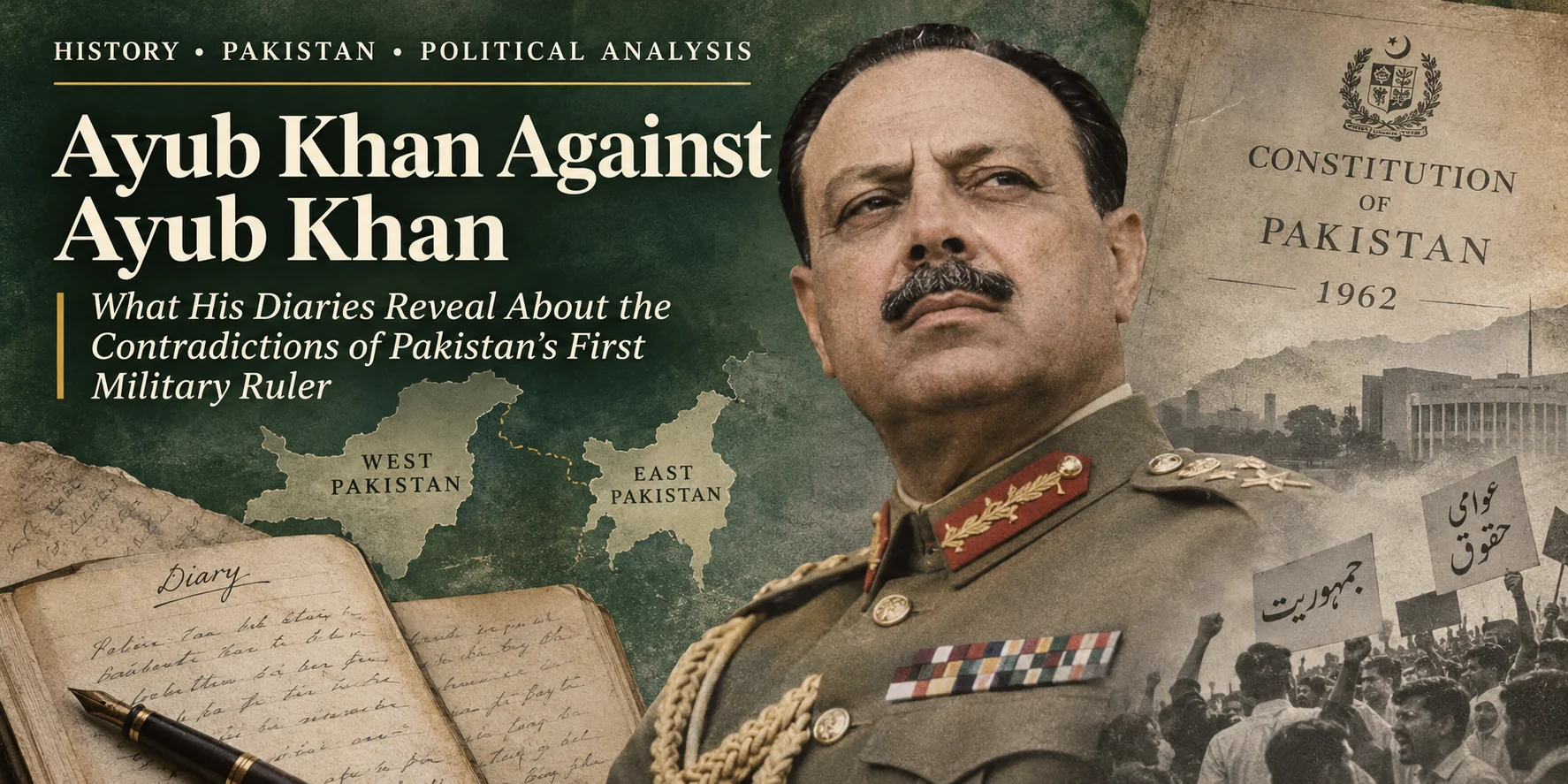
Table of contents9 sections
Ayub Khan Against Ayub Khan: The Contradictions Revealed by His Own Diaries
He promised democracy but distrusted voters. He championed national unity but resisted the political demands of Pakistan’s majority. He defended constitutional government but handed power to another general. More than five decades after his death, Ayub Khan’s own writings offer a revealing perspective on the contradictions of his rule.
On 25 March 1969, Field Marshal Muhammad Ayub Khan surrendered the presidency of Pakistan to General Agha Muhammad Yahya Khan.
It was an extraordinary end to a presidency that had lasted more than a decade.
The man who had promised to rescue Pakistan from political instability, establish durable institutions, and introduce a democratic system suited to the country’s circumstances departed amid nationwide protests, constitutional uncertainty, and growing tensions between East and West Pakistan.
He had come to power through martial law. He left power by transferring authority to another military ruler.
Ayub lived another five years, dying on 19 April 1974. During his retirement, he witnessed events that would fundamentally transform the country he had governed: Pakistan’s first general elections based on universal adult franchise, the political confrontation over their results, the military crackdown in East Pakistan, the 1971 war, the emergence of Bangladesh, and the rise of Zulfikar Ali Bhutto.
He also left behind a remarkable historical record.
His private diaries, covering September 1966 to 1972, were published in 2007 under the editorship of historian Craig Baxter. They offer an unusually personal view of Ayub’s political thinking, including his anxieties about democracy, his distrust of civilian politicians, and his fears about Pakistan’s future.
The diaries are particularly interesting because Ayub was no ordinary observer. He had exercised enormous authority over the political system whose weaknesses he subsequently described.
That raises a question worth examining: How consistently did Ayub Khan apply to himself the political principles he expected others to follow?
The answer reveals a leader who often understood the dangers confronting Pakistan but whose preferred solutions sometimes contributed to those very dangers.
1. The Defender of Constitutional Government Who Abandoned His Own Constitution
The most striking contradiction of Ayub Khan’s presidency emerged in its final days.
On 24 March 1969, as his government struggled against widespread unrest, Ayub recorded in his diary that he had written to Army Chief General Yahya Khan explaining why civilian authority could no longer function effectively.
In the letter, he described the armed forces as:
“the only effective and legal instrument”
The significance of this statement lies in Ayub’s understanding of political legitimacy.
When civilian institutions appeared incapable of maintaining order, he considered military authority a legitimate alternative.
But Ayub was not merely a president confronting a constitutional crisis. He was the architect of the constitutional system he was about to abandon.
His government had introduced the Constitution of 1962, which established a powerful presidency and provided a mechanism for presidential succession.
Under Article 16, the Speaker of the National Assembly was to perform presidential functions in the event of a vacancy, pending the election of a successor.
In March 1969, that position was held by Abdul Jabbar Khan.
Yet Ayub did not transfer authority to the constitutional successor. Instead, he handed power to Yahya Khan, who imposed martial law and abrogated the constitution.
The decision was consistent with Ayub’s long-standing belief that the military represented Pakistan’s most disciplined and dependable institution. It was much harder to reconcile with his claim to have established a functioning constitutional order.
His defenders could argue that the country faced exceptional circumstances and that an ordinary constitutional transition might not have restored order.
That argument deserves consideration. Pakistan was experiencing a serious political crisis, and Ayub’s ability to govern had deteriorated substantially.
But the deeper problem remains.
A constitution is most valuable when political circumstances become difficult. If its provisions can be set aside whenever the government considers them inconvenient, constitutional authority becomes subordinate to the judgment of those holding power.
Ayub had spent years presenting his political system as an answer to Pakistan’s institutional instability. Yet at the moment of succession, he relied on the military rather than the institutions he had created.
The contradiction was not merely personal. It exposed a structural weakness in his entire political project.
Sources: Ayub Khan, diary entry of 24 March 1969, as discussed in published reviews of his diaries; Constitution of Pakistan, 1962, Article 16; US government memorandum concerning Pakistan, 25 March 1969.
2. The Champion of Democracy Who Distrusted the Voters
Ayub Khan did not publicly reject democracy. On the contrary, he repeatedly argued that his government was creating a more appropriate form of it.
In March 1965, he published an article titled A New Experiment in Democracy in Pakistan in The ANNALS of the American Academy of Political and Social Science.
There, he defended the political system established after his takeover in 1958.
His central argument was that Pakistan’s earlier parliamentary experiment had produced instability, corruption, and ineffective government. The country therefore required democratic institutions adapted to its social conditions rather than an uncritical imitation of Western parliamentary systems.
The result was the Basic Democracies system.
Instead of allowing the entire adult population to elect the president directly, Ayub established an electoral college of 80,000 Basic Democrats, later expanded to 120,000, who exercised electoral functions within his political framework.
He presented this as a practical method of bringing democracy closer to ordinary people.
Yet his private writings reveal considerable skepticism about allowing those same people to exercise direct political authority.
On 13 April 1969, shortly after leaving office, Ayub reacted to Yahya Khan’s proposal to introduce elections based on direct adult franchise.
He reportedly dismissed the idea as:
“the height of wishful thinking.”
Elsewhere in his diaries, Ayub questioned the ability of ordinary villagers, particularly those with limited education and exposure to national affairs, to make informed decisions about parliamentary representation.
These concerns were not unique to Ayub. Debates about literacy, political education, and the suitability of different electoral systems have existed in many countries.
Nor is indirect election inherently undemocratic. Democratic systems can legitimately employ electoral colleges and representative institutions.
The crucial distinction is whether the arrangement allows meaningful political competition and public accountability.
In Ayub’s Pakistan, the presidency was extraordinarily powerful, political competition was restricted, and the electoral system substantially insulated the head of state from direct public judgment.
His preference for indirect elections therefore cannot be separated from the concentration of authority within his government.
Ayub believed Pakistan needed democracy, but he was reluctant to trust the electorate with the power to determine who governed it.
This was the central contradiction of his democratic experiment.
He wanted popular participation, but within boundaries established by the state. He wanted political representation, but feared the consequences of unrestricted electoral competition.
In effect, he treated democracy less as a means through which citizens could control government and more as an administrative system through which government could organize political participation.
Sources: Muhammad Ayub Khan, A New Experiment in Democracy in Pakistan, March 1965, pp. 109–113; Ayub Khan, diary entry of 13 April 1969; additional discussions of elections in his published diaries.
3. The Advocate of National Unity Who Distrusted Pakistan’s Majority
Perhaps no issue exposes the limitations of Ayub Khan’s political philosophy more clearly than his approach to East Pakistan.
Throughout his presidency, Ayub expressed concern about the relationship between Pakistan’s two wings.
He understood that the country’s geographical separation, economic disparities, cultural differences, and competing political demands presented serious challenges to national unity.
His diaries suggest that he was aware of the possibility of East Pakistan’s eventual separation well before Bangladesh became independent.
In an entry dated 23 July 1967, Ayub described a conversation with Altaf Gauhar concerning how long East Pakistan might remain united with West Pakistan.
According to the account discussed by journalist Syed Badrul Ahsan, Ayub suggested that the eastern wing would remain part of Pakistan until India was ready to absorb it.
The remark is revealing, although it should be interpreted cautiously.
It reflected Ayub’s strategic fears about India, but it also suggested that he viewed East Pakistan’s future primarily through the lens of external security rather than political consent within the federation.
That distinction matters because East Pakistan’s principal constitutional grievance concerned representation.
The eastern wing contained a majority of Pakistan’s population. Yet the political arrangements inherited and maintained under Ayub’s government treated East and West Pakistan as equal units for representation in the central legislature.
This principle was known as parity.
Supporters of parity believed it protected West Pakistan from permanent political domination by the more populous eastern wing.
For many Bengalis, however, parity meant something quite different: their numerical majority did not translate into corresponding representation at the national level.
The contradiction became increasingly apparent as demands for regional autonomy intensified.
Sheikh Mujibur Rahman’s Six-Point Programme, introduced in 1966, sought a substantially different constitutional relationship between the centre and the provinces.
Ayub regarded these demands as potentially dangerous to the federation.
Yet resisting them did not resolve the underlying question of how a democratic Pakistan should accommodate its majority population.
In March 1969, during the Round Table Conference, Ayub accepted proposals for a parliamentary system and elections based on adult franchise. But disagreement over parity and regional autonomy remained.
His later diary entries demonstrate that these concerns persisted even after he left office.
On 27 November 1969, Ayub expressed apprehension about Yahya Khan’s plans to abolish One Unit and introduce representation based on population.
From Ayub’s perspective, such changes threatened the political balance that held Pakistan together.
From the perspective of Bengali nationalists, they represented overdue recognition of democratic rights.
Both sides feared domination, but they defined the danger differently.
Ayub feared that majority rule would weaken the federation. Bengali nationalists feared that a federation unwilling to recognize its majority could never provide genuine political equality.
Ayub wanted to preserve a united Pakistan, but he remained deeply suspicious of constitutional arrangements that would give the majority of Pakistanis political power proportionate to their numbers.
This does not mean that Ayub alone caused Pakistan’s breakup.
The catastrophe of 1971 occurred under Yahya Khan, following the disputed transfer of power, military action in East Pakistan, civil war, Indian intervention, and the defeat of Pakistani forces.
Nevertheless, the constitutional disputes that contributed to the crisis had developed over many years, including during Ayub’s presidency.
His diaries are valuable because they reveal how a leader could recognize the danger of national disintegration while remaining unwilling to accept political arrangements that might have addressed some of its underlying causes.
Sources: Ayub Khan, diary entries of 23 July 1967 and 27 November 1969; Syed Badrul Ahsan’s discussion of the diaries in Dhaka Courier; Dawn’s archival coverage of the March 1969 Round Table Conference.
4. The Leader Who Condemned Political Ambition but Concentrated Power in Himself
Ayub Khan frequently expressed frustration with civilian politicians.
He regarded many of them as opportunistic, undisciplined, and more interested in acquiring power than building stable institutions.
His diaries contain repeated concerns about the growing influence of political leaders who challenged his government.
On 23 February 1969, as his presidency approached its end, Ayub reflected on the popularity of Zulfikar Ali Bhutto in West Pakistan and Sheikh Mujibur Rahman in East Pakistan.
Their simultaneous rise troubled him.
Both men commanded substantial political support, but both also represented challenges to the centralized political order Ayub had established.
Three days later, Ayub recorded a cordial meeting with Mujib and acknowledged his commanding position in East Pakistani politics.
These entries reveal an important tension.
Ayub understood that civilian leaders could acquire genuine public influence. Yet he often regarded their growing authority as a threat to national stability.
Compare this attitude with his own political career.
Ayub had become Pakistan’s military ruler in October 1958, initially serving as Chief Martial Law Administrator before displacing President Iskander Mirza.
He subsequently established a presidential system in which executive authority was heavily concentrated.
His government also used the Elective Bodies Disqualification Order, commonly known as EBDO, to exclude numerous politicians from public office and political activity.
Ayub justified such restrictions as necessary to protect Pakistan from corruption and political disorder.
But the standard he applied to civilian politicians was difficult to reconcile with his own accumulation of authority.
Political ambition was dangerous when exercised by his opponents, but centralized power was presented as a national necessity when exercised by Ayub himself.
This does not establish that Bhutto or Mujib were beyond criticism. Both were political actors whose decisions and ambitions deserve independent historical scrutiny.
The issue is consistency.
Ayub regarded civilian political competition as a potential source of instability while treating his own extraordinary authority as the means of preventing it.
His diaries suggest that he never fully resolved this contradiction.
Sources: Ayub Khan, diary entries of 23 and 26 February 1969; contemporary and retrospective accounts in Dhaka Courier and The Daily Star; Ayub Khan’s 1965 defence of his presidential system; historical accounts of EBDO.
5. The Modernizer of Women’s Rights Who Opposed Fatima Jinnah’s Political Leadership
Ayub Khan’s record on women’s rights presents a different kind of contradiction.
In 1961, his government introduced the Muslim Family Laws Ordinance, one of the most consequential pieces of family-law legislation in Pakistan’s early history.
The ordinance introduced legal requirements concerning marriage registration, polygamy, divorce, and related family matters.
Its provisions were intended, among other purposes, to provide women with greater legal protection within marriage.
The legislation encountered opposition from conservative religious circles, but Ayub’s government proceeded with it.
This willingness to challenge established social and religious opinion became an important part of his image as a modernizing ruler.
Yet the presidential election of 1965 exposed the limits of that modernizing approach.
Ayub’s principal opponent was Fatima Jinnah, the sister of Pakistan’s founder, Muhammad Ali Jinnah.
She was not simply another opposition politician.
Widely respected for her association with the Pakistan Movement, Fatima Jinnah became the candidate of a coalition of opposition parties seeking to challenge Ayub’s rule.
Her candidacy presented Ayub with a serious political problem.
Rather than relying exclusively on disagreements over constitutional policy or government performance, elements of the pro-Ayub campaign challenged the suitability of a woman to hold the presidency.
Religious arguments were employed to question whether a woman could legitimately serve as head of state.
Research drawing on the Fatima Jinnah Papers and contemporary newspaper accounts has also documented personal attacks on her political competence and public role.
A remark attributed to Ayub during the campaign captures the dismissive tone of some of these attacks:
“They call her the Mother of the Nation…then she should at least behave like a mother!”
The precise wording and context of this reported statement should be checked against the original archival citation before treating it as a verbatim quotation.
The contradiction was not that Ayub opposed Fatima Jinnah. Political opposition is legitimate, and her candidacy could reasonably be challenged on policy grounds.
The contradiction lay in the methods used against her.
A government that had defended legal reforms benefiting women also benefited politically from arguments that questioned a woman’s suitability for the highest public office.
The episode was especially revealing because some religious political figures and organizations that had opposed Ayub’s social reforms nevertheless supported Fatima Jinnah.
The dispute demonstrated that positions on women’s political leadership were not determined solely by religious ideology. They were also shaped by political interests and alliances.
Ayub’s modernizing credentials were therefore more complicated than his legislative record alone might suggest.
Sources: Muslim Family Laws Ordinance, 1961; Gender, Dissent and the Afterlives of the Pakistan Movement: Fatima Jinnah in the 1965 Elections (2024); research on official Islamic policy under Ayub Khan.
6. The Architect of Stability Whose Institutions Could Not Survive Him
Ayub Khan’s strongest claim to political legitimacy was that he had restored stability.
When he assumed power in 1958, Pakistan had experienced repeated changes of government, political infighting, and serious constitutional difficulties.
Ayub presented military intervention as a necessary response to these failures.
His government subsequently pursued economic planning, industrial development, major infrastructure projects, and administrative reforms.
The economy experienced substantial growth during parts of his presidency.
These achievements should not be dismissed simply because Ayub governed through an authoritarian political system.
Historical evaluation requires distinguishing economic performance from political legitimacy and institutional durability.
Yet Ayub’s central political claim went beyond economic development.
He argued that his system could provide Pakistan with the stable government that parliamentary politics had supposedly failed to deliver.
That claim deserves examination in light of what happened when his personal authority weakened.
By 1968, opposition to Ayub had expanded across different sections of Pakistani society.
Students, workers, opposition politicians, and regional movements participated in protests that increasingly challenged the legitimacy of his presidency.
The government’s response failed to restore lasting political confidence.
By early 1969, Ayub faced a crisis that his own political institutions could not resolve.
An American intelligence assessment from February 1969 questioned the durability of the political order he had created and warned about Pakistan’s uncertain future.
Ayub eventually concluded that civilian authority could no longer maintain order.
The result was another transfer of power to the military.
This exposed a distinction that is frequently overlooked in assessments of authoritarian modernization.
A government can maintain order for years without creating institutions capable of managing political conflict after its leader departs.
Ayub’s government had demonstrated the ability to exercise authority. It had not demonstrated an equivalent ability to transfer that authority peacefully through a durable constitutional process.
The Basic Democracies system depended heavily on the presidency. Political parties had operated under restrictions. Constitutional authority remained vulnerable to military intervention.
When Ayub’s personal legitimacy collapsed, the political system offered no effective mechanism for resolving the crisis.
His government had achieved a measure of administrative stability, but that stability proved heavily dependent on the man at its centre.
Sources: Ayub Khan, A New Experiment in Democracy in Pakistan (1965); US government assessments of Pakistan’s political crisis, February 1969; Ayub Khan, diary entry of 24 March 1969.
What Ayub Khan’s Diaries Really Reveal
It would be tempting to read Ayub Khan’s diaries as evidence of a ruler who understood Pakistan’s problems but knowingly refused to solve them.
That interpretation is too simple.
His writings suggest a more complicated political personality.
Ayub appears to have sincerely believed that Pakistan needed strong central leadership, disciplined administration, and protection from what he regarded as the excesses of competitive politics.
He feared that unrestricted political competition could intensify regional divisions, encourage opportunistic politicians, and weaken national institutions.
He was particularly concerned about the possibility that political demands in East Pakistan would threaten the federation.
These fears were not entirely imaginary.
Pakistan faced genuine challenges involving regional identity, constitutional representation, economic inequality, political legitimacy, and relations with India.
But recognizing a danger does not necessarily mean understanding how to prevent it.
Ayub’s preferred solutions repeatedly brought him into conflict with the principles he claimed to defend.
He advocated democracy while distrusting direct elections.
He defended constitutional government while bypassing constitutional succession.
He feared the breakup of Pakistan while resisting demands for greater representation from its majority population.
He criticized the ambitions of civilian politicians while concentrating extraordinary power in his own hands.
He supported legal reforms benefiting women while his political campaign against Fatima Jinnah drew upon arguments questioning women’s eligibility for national leadership.
And he promised institutional stability while leaving behind a political order unable to survive his departure.
Taken individually, some of these contradictions can be explained through political circumstances, security concerns, or differences in constitutional philosophy.
Taken together, they reveal a recurring pattern.
Ayub Khan trusted institutions when they supported his vision of Pakistan, but he was reluctant to accept their authority when they threatened that vision.
This is perhaps the most important insight offered by his political career.
A necessary caution about the diaries
The diaries should not be treated as an impartial historical record.
They reflect Ayub’s own interpretation of events, including his personal judgments, political grievances, and retrospective assessments.
The published volume appeared decades after his death, and questions have been raised about the preparation and reliability of the diary material.
For that reason, individual entries should be compared with contemporary newspapers, official correspondence, constitutional documents, diplomatic records, and other historical accounts.
Where diary passages are known only through secondary reviews or published extracts, they should be identified as such rather than presented as independently verified quotations from the original manuscript.
These limitations do not make the diaries irrelevant. They simply mean that Ayub’s words must be examined critically, just as the claims of his opponents should be.
Conclusion: The Failure of a System Built Around One Man
Ayub Khan remains one of the most consequential and contested figures in Pakistan’s history.
His supporters remember a period associated with economic growth, infrastructure development, administrative discipline, and an ambitious vision of modernization.
His critics remember the suspension of democratic politics, concentration of executive authority, restrictions on political competition, and unresolved tensions between East and West Pakistan.
Both perspectives address important parts of his historical record.
But the most revealing question may be neither whether Ayub was a successful modernizer nor whether he was an authoritarian ruler.
It is whether the political system he created could function independently of him.
His departure in March 1969 provides a troubling answer.
After more than a decade of centralized rule, Pakistan did not experience an orderly constitutional succession. Instead, another army chief assumed power, martial law returned, and the country entered an even more dangerous period of political uncertainty.
Ayub spent part of his retirement observing the consequences of that uncertainty.
He witnessed Pakistan’s disintegration in 1971, an outcome he had long feared but did not live to prevent.
It would be historically inaccurate to attribute that catastrophe to Ayub alone. The decisions made after his resignation, particularly during the crisis of 1970–71, were decisive.
Nevertheless, his presidency formed an important part of the political history that preceded it.
His diaries therefore leave us with a question larger than the reputation of one military ruler.
Can a leader genuinely strengthen a country while weakening the institutions through which its people are supposed to govern themselves?
Ayub Khan believed that strong leadership could overcome the weaknesses of Pakistan’s political system.
The irony is that his own rule demonstrated how vulnerable a country can become when political stability depends too heavily on a single individual.
He recognized many of the dangers facing Pakistan. He warned about political division, irresponsible leadership, and the fragility of national unity.
But the most consequential contradiction of his career was that the political arrangements he believed would protect Pakistan may also have made it less capable of resolving those dangers peacefully.
Ayub Khan’s tragedy was not simply that he failed to prevent the crises he feared. It was that his own methods of government helped create the institutional weaknesses through which those crises deepened.
Sources and Further Reading
Primary writings and contemporary records
-
Muhammad Ayub Khan, Diaries of Field Marshal Mohammad Ayub Khan, 1966–1972. Edited by Craig Baxter. Oxford University Press, 2007. The principal collection of Ayub’s private reflections. Google Books.
-
Muhammad Ayub Khan, A New Experiment in Democracy in Pakistan. The ANNALS of the American Academy of Political and Social Science, Vol. 358, March 1965, pp. 109–113. Ayub’s public defence of his political system. Journal article.
-
Constitution of the Republic of Pakistan, 1962. Particularly Article 16, concerning presidential succession. The relevant constitutional text should be consulted when assessing the legality of the March 1969 transfer of power.
-
Muslim Family Laws Ordinance, 1961. Primary legislation concerning marriage, divorce, polygamy, and related family-law matters. Pakistan Code.
Historical analysis and supporting material
-
United States Department of State, Foreign Relations of the United States. Diplomatic records concerning Pakistan’s political crisis and the transfer of power in March 1969. Office of the Historian.
-
Dawn historical archives. Contemporary reporting on the March 1969 Round Table Conference and the final months of Ayub’s presidency.
-
Syed Badrul Ahsan, discussions of Ayub Khan’s diaries. Commentary on Ayub’s views of East Pakistan, Sheikh Mujibur Rahman, and the constitutional disputes preceding Bangladesh’s independence.
-
Gender, Dissent and the Afterlives of the Pakistan Movement: Fatima Jinnah in the 1965 Elections (2024). Research examining Fatima Jinnah’s presidential campaign, gendered political attacks, and archival evidence. Full bibliographic details and archival references should be verified before publication.